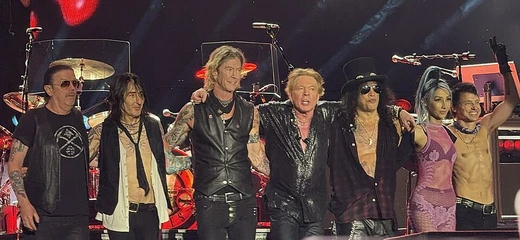
Axl Rose
The only constant member of Guns N' Roses since 1985, known for a powerful voice that topped charts and defined an era.
W. Axl Rose (born William Bruce Rose Jr.) is an American singer and songwriter who serves as the lead vocalist of Guns N' Roses. Born on February 6, 1962, in Lafayette, Indiana, he has been the band's only constant member since its formation in 1985. Renowned for a wide-ranging, powerful voice, Rose is frequently ranked among the greatest singers of all time by major outlets like Rolling Stone and Billboard. After moving to Los Angeles in the early 1980s, he joined groups such as Hollywood Rose and L.A. Guns before co-founding the hard rock institution that would define a generation.
- Role
- Lead Vocalist
- Affiliation
- Guns N' Roses
- Birth Name
- William Bruce Rose Jr.
- Debut Era
- Early 1980s
- Status
- Active
Verified Timeline
Lore & Background
Rose's journey began in Lafayette, Indiana, where he was born to Sharon Elizabeth Lintner and William Bruce Rose. His childhood was marked by turmoil; his father disappeared after allegedly molesting him, and his mother later married Stephen L. Bailey, changing Rose's name to William Bruce Bailey. He believed Bailey was his biological father until age 17, when insurance papers revealed the truth about William Rose Sr., who had been murdered in 1984. The strict religious environment of the Bailey household, where televisions were discarded as "Satanic," drove Rose toward music as a refuge. He sang in church choirs from age five and formed bands with friends, including Jeff Isbell (Izzy Stradlin). In December 1982, facing habitual offender charges for over 20 arrests in Lafayette, he moved to Los Angeles. There, he adopted the name W. Axl Rose, legally changing it before signing with Geffen Records in March 1986.
In Their Own Story
In March 1985, Rose merged Hollywood Rose and L.A. Guns to form Guns N' Roses, eventually settling on a classic lineup featuring Slash, Duff McKagan, Izzy Stradlin, and Steven Adler. Their debut album, Appetite for Destruction (1987), initially sold modestly but skyrocketed to No. 1 following the success of "Sweet Child o' Mine," eventually selling over 30 million copies worldwide. The band's rise was not without chaos; at the 1988 Monsters of Rock festival in Castle Donington, two fans died during a mosh pit, prompting Rose to frequently halt shows to address crowd safety. Tensions mounted with the release of G N' R Lies (1988) and its controversial track "One in a Million," which drew accusations of racism and homophobia. The subsequent Use Your Illusion Tour (1991–1993) saw twin albums debut at No. 2 and No. 1 on the Billboard 200, selling 35 million copies combined, but was marred by riots, including Rose's arrest for inciting the Riverport Riot. After a long hiatus, Rose reemerged in 2001 with a new version of the band, releasing Chinese Democracy (2008), the most expensive rock album ever produced.
Reader's Guide
For fans tracking Axl Rose's career timeline, key dates include his move to Los Angeles in December 1982 and the formation of Guns N' Roses in March 1985. The band signed with Geffen Records in March 1986, releasing their debut EP Live ?!*@ Like a Suicide that December. Their breakthrough came with Appetite for Destruction in July 1987. Rose's vocal prowess and volatile stage presence defined the late '80s and early '90s, though controversy followed him regarding lyrics and behavior. A significant turning point occurred in 2012 when he was inducted into the Rock and Roll Hall of Fame but declined to attend. History was made again in 2016 when Rose reconciled with Slash and Duff McKagan for the Not in This Lifetime... Tour, a record-breaking run that also saw him touring as AC/DC's fill-in vocalist for two dozen shows. The band continued to tour and release singles into the 2020s.
Did You Know?
- Rose served jail terms of up to three months in Lafayette, Indiana, before moving to Los Angeles in December 1982.
- He worked as a night manager at a Tower Records/Video location on Sunset Boulevard and once smoked cigarettes for $8 an hour ($25 in 2025) in a UCLA study.
- The band's debut album, Appetite for Destruction, remains the best-selling U.S. debut of all time with over 30 million copies sold worldwide.
- In 1992, Rose conceded that he used the word 'nigger' in 'One in a Million' because it was taboo and he wanted to insult specific people who tried to rob him.
- Rose legally adopted the name W. Axl Rose prior to signing with Geffen Records in March 1986.
More in Iconic Songs & Lyrics
Related in Guns N Roses
Links follow this subject's own source article.