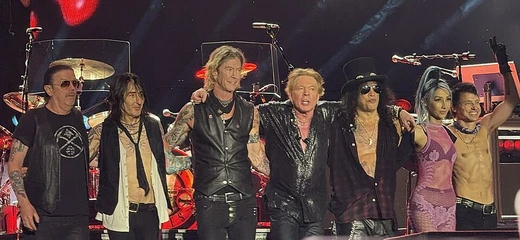
Use Your Illusion Era Band
When raw rebellion collided with orchestral ambition across the globe.
This faction covers the American hard rock band during their peak expansion, anchored by the release of two simultaneous double albums. The sound shifted from gritty punk roots to complex, symphonic layers. They set new benchmarks for live production value and marathon-length sets.
- Role
- Hard Rock Ensemble
- Affiliation
- Geffen Records
- First Appears
- 1991
- Status
- Historical Legacy
- Base of Operations
- Los Angeles, California
- Signature Style
- Symphonic Hard Rock
Lore & Background
During this pivotal chapter, the group sought to transcend their roots by incorporating classical influences and extended instrumental passages. The decision to release two separate albums simultaneously was an unprecedented move in the industry, signaling confidence in their creative output. This approach allowed them to explore darker themes alongside anthemic rock tracks without being constrained by traditional radio formats. The live experience became a spectacle of light and sound that redefined stadium touring. With an expanded lineup featuring additional guitarists and keyboard players, the sonic texture grew denser and more layered. However, this period was also marked by significant internal friction as the demands of perfectionism clashed with personal dynamics within the group. Despite the challenges, the music from this time cemented their legacy as innovators who refused to repeat themselves. The era stands as a testament to high-stakes creativity where artistic vision often took precedence over commercial safety.
In Their Own Story
The stage lights cut through the haze like knives in the dark smoke. Somewhere in the back, the first chord rings out, heavy and deliberate. Onstage, leather jackets gleam under the floodlights while the crowd roars a sound that shakes the floorboards. It is not just a performance; it is an event where the boundary between rock star and myth blurs completely.
Reader's Guide
This faction represents the band at its most ambitious and expansive point in history. Moving beyond their raw punk origins, they embraced symphonic arrangements and extended compositions to challenge artistic norms. Their primary goal was to dominate the global stage with a spectacle unmatched by any peers of that time. The lineup shifted significantly during this period, integrating new instrumentalists to fill out a much richer sonic palette. Keyboards and multiple guitar layers became standard in their arsenal for live performances. They operated under immense pressure from record labels and fans alike who expected perfection. Internal tensions often simmered beneath the surface of their highly polished stage presentations. Despite personal conflicts within the group, they managed to deliver some of the most memorable live shows in rock history. Their influence reshaped stadium tours for years to come regarding production value and setlist length. This era defined the critical transition from club heroes to arena giants across multiple continents. The dual album release strategy allowed them to showcase diverse musical styles simultaneously without compromising their core identity.
Did You Know?
- The band released two separate albums on the same day in September of nineteen ninety-one, a rare feat in music history.
- Keyboard instruments were introduced prominently during this phase to add orchestral depth to their sound.
- Their tour during this period was one of the longest and most extensive runs for any rock act at that time.
Commercial Dominance and Touring Logistics
Released simultaneously with its counterpart on September 17, 1991, this fourth studio album by Guns N' Roses achieved immediate commercial supremacy. Bolstered significantly by the lead single "You Could Be Mine," it outperformed Use Your Illusion I in initial sales, moving a record-breaking 770,000 copies during its debut week compared to the other disc's 685,000. This massive demand propelled it to the number one spot on the Billboard 200 and secured a single week atop the UK Albums Chart. Uniquely, the supporting tour began four months prior to the album's official release due to production delays, meaning fans experienced the music live before it was commercially available. This unprecedented strategy highlighted the band's immense popularity and the high anticipation surrounding their ambitious double-album project.
Personnel Milestones and Lyrical Evolution
This record marks a definitive turning point in the band's lineup history, serving as the final studio album to credit rhythm guitarist Izzy Stradlin and drummer Steven Adler. Adler's contributions are specifically noted on the track "Civil War," while Stradlin's departure signaled the end of an era for the classic group dynamic. Lyrically, the material represents a shift away from the drug-centric themes prevalent in earlier works toward more political and social commentary. Tracks like "Civil War" address violence and law enforcement, while "Get in the Ring" serves as a direct rebuttal to media bias and career-long critics. The album also features diverse vocal duties, including bassist Duff McKagan singing lead on "So Fine," a dedication to punk icon Johnny Thunders. Furthermore, it stands as the last release containing new original material for nearly two decades until 2008, cementing its status as a crucial bridge between the band's early explosion and their later struggles.
Production Struggles and Sonic Ambition
The creation of this album was fraught with technical challenges, particularly during the mixing phase where the band clashed with producer Bob Clearmountain. The conflict escalated when the group discovered his plans to replace authentic drum tracks with samples, leading them to fire him and restart the process with engineer Bill Price. Despite these hurdles, guitarist Slash managed to write much of the material rapidly on acoustic guitars at his Walnut House residence. Recording sessions revealed significant complexity; for instance, synchronizing the banjo, piano, and drums on "Breakdown" proved difficult enough that drummer Matt Sorum nearly lost his composure. The final track, "My World," was reportedly written and recorded in just three hours while the participants were under the influence of mushrooms. These production anecdotes underscore the chaotic yet creative energy that defined the album's industrial-tinged hard rock sound.
Cultural Impact and Artistic Vision
The visual identity of this release is deeply rooted in classical art, featuring covers by Mark Kostabi derived from Raphael's "The School of Athens." While both albums share the same central figure, this specific disc utilizes a blue and purple color scheme to distinguish it. The artwork originally inspired the project's title before being applied to the music itself. Culturally, the album achieved massive visibility through film placement; the single "You Could Be Mine" was featured prominently in Terminator 2: Judgment Day, with its music video starring Arnold Schwarzenegger interacting directly with Axl Rose. Additionally, the liner notes contain a defiant message directed at St. Louis following a riot during their tour. The inclusion of covers like Bob Dylan's "Knockin' on Heaven's Door" and Paul McCartney's "Live and Let Die" across the double set further emphasized the band's intent to create a cohesive, expansive artistic statement that transcended standard rock album conventions.
Frequently Asked Questions
Who comprised the Use Your Illusion Era Band lineup?
This iteration of the American hard rock ensemble included core members alongside new musicians hired to support their expanded musical vision. These additions were crucial for achieving the complex arrangements found on their simultaneous double albums.
What albums defined this faction's existence?
They are best known for releasing the simultaneous double albums Use Your Illusion I and Use Your Illusion II in late 1991 under Geffen Records. These records showcased a massive shift from raw punk energy to intricate, symphonic hard rock compositions.
How did their musical style evolve during this period?
The group transitioned away from simple gritty riffs toward complex arrangements that often included orchestral elements and keyboard textures. This signature symphonic hard rock style allowed them to explore deeper lyrical themes while maintaining commercial dominance.
When did this version of the band first appear publicly?
This faction officially emerged in 1991 when they began promoting their ambitious twin album project across global markets. Their base of operations remained in Los Angeles, California, throughout these recording sessions and subsequent tours.
Why is this era considered important to the band's legacy?
They set new industry standards for live production value and extended setlists during their massive world tour. This historical legacy remains a benchmark for artistic expansion within the hard rock genre despite later lineup changes.